
The Pressure Builds Across Eredivisie Before the Season Begins
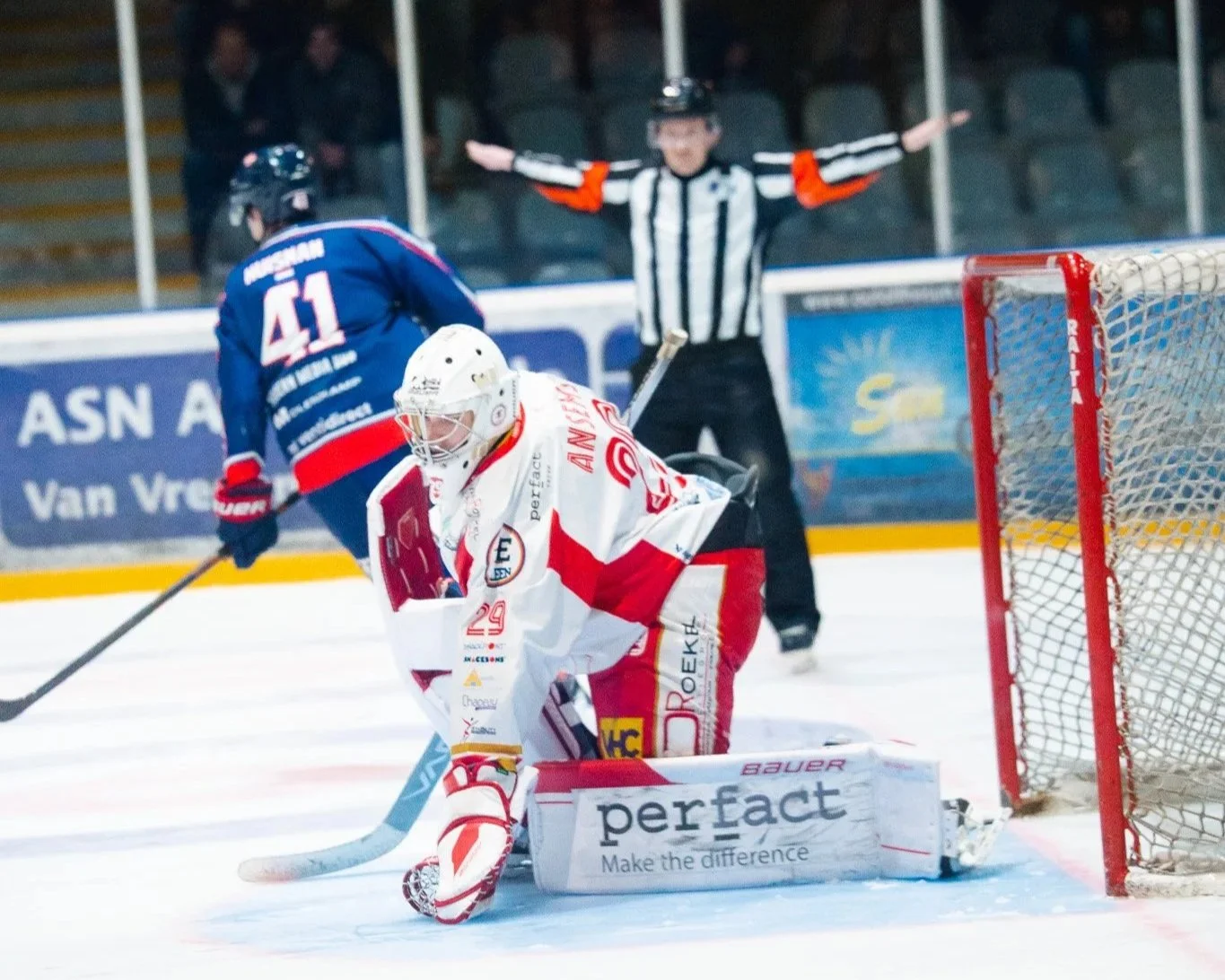
Smoke Eaters goalie Jowin Ansems during a matchup against HIJS Hokij at De Uithof Arena on December 16, 2025. (Photo by Sven Highland @svenhighland).
Written by Gina Anton
The puck has not dropped yet, but the pressure is already here.
Across the Eredivisie, teams are back on the ice, preseason games are underway and players are settling into new lineups ahead of the 2026–27 season. The regular season does not begin until September 25, but for many players, the work of proving themselves has already started.
This season, the league looks different. JUMBO Flyers Heerenveen, HIJS Hokij Den Haag and Solify Smoke Eaters Geleen are entering the Eredivisie after competing in the CEHL, while players have also moved between clubs during the offseason. That has created new line combinations, new opportunities and, perhaps most importantly, new expectations.
But the pressure is not the same everywhere.
The Teams With Something to Prove
For the three former CEHL teams, the challenge is more than simply adjusting to a new league. They are bringing recent experience against strong international competition with them, which raises expectations around what they can accomplish in the Eredivisie.
Geleen may have one of the clearest expectations. The club has set its sights on a top-four finish, meaning there is already a standard attached to the season before the first official game. Levi Smeets has a personal connection to that goal, returning to the Smoke Eaters after six seasons with the Liège Bulldogs and having come through Geleen’s youth system.
Alongside him, Finnish forward Janne Jokinen gives the team an offensive addition after a successful season with the Milton Keynes Lightning, where he finished with 46 points, including 21 goals and 25 assists. For Geleen, the combination of familiar faces returning home and proven offensive production could make the pressure to deliver on those top-four expectations even greater. For players like Smeets, returning to a club where he developed as a youth player can also bring a different kind of pressure, as expectations from both the team and the community begin to build.
For Heerenveen and Den Haag, the pressure comes in a different form. Both teams are returning to a league where they are expected to compete immediately, but their rosters have also changed. Den Haag, for example, added Justus Mikkonen after he recorded 49 points in 34 CEHL games with Heerenveen last season. That kind of production creates expectations for Mikkonen in a new jersey while leaving Heerenveen with an important offensive role to replace.
The transition is not simply about where these teams finished last season. It is about whether the players who helped them compete at the CEHL level can carry that standard into a different league, and how they handle the expectations that come with being asked to do it again in a new environment.
The Defending Champion Has a Different Problem
Then there is Nijmegen.
The defending Dutch champion does not have to prove that it belongs in the Eredivisie. It has to prove it can stay on top.
Nijmegen went 20-0 in regulation during the regular season, with one overtime win and one overtime loss, scoring 190 goals while allowing 47 across 22 games.
Those numbers make the pressure around the Devils difficult to ignore. Antons Trastasenkovs produced 78 points in only 21 games, while Mitch Bruijsten finished with 64 points in 22 games. Their production helped create the standard the rest of the league will now be trying to challenge.
For Nijmegen, another championship would confirm that last season was not an isolated run. Anything less could make the defending champion one of the most closely watched teams in the league. For the players who helped deliver that championship, there is also the challenge of returning to the ice knowing that the standard has already been set and that every game will be measured against it.
Every Move Changes Something
Player movement adds another layer to that pressure.
When a player leaves one Eredivisie team for another, the impact does not stay with one roster. A new opportunity is created for one player, a hole appears somewhere else and expectations shift with it.
Mikkonen's move from Heerenveen to Den Haag is one example. Kyan Helenklaken also moved from Den Haag to Amsterdam, showing how offseason movement can change the makeup of teams across the league.
That makes preseason more important than simply getting games in. Coaches are evaluating combinations, players are competing for roles and new teammates are learning how to play together before the results officially count. For players in new situations, those games can also be an early chance to show coaches and teammates that they can live up to the expectations that came with their move.
For players coming into new situations, there is also the pressure of living up to what their previous season suggested they could become. A strong past season can open a new opportunity, but it can also create expectations that follow a player into a new dressing room.
When Expectations Become Reality
By September 25, the standings will start at zero. Expectations will not.
Fans have already watched their teams rebuild, seen familiar players leave and new ones arrive, and started forming ideas about what this season could look like. The players feel that too. For some, it is the pressure of trying to defend a championship. For others, it is proving that a strong season in the CEHL can translate to success in the Eredivisie. For players changing teams, it may simply be proving that the move was the right one.
That pressure can look different from player to player. It can come from trying to earn a bigger role, replacing a player who left, adjusting to a new team or simply trying to meet the expectations that come with a successful season. Before the first game is even played, players are already carrying those expectations onto the ice.
That is what makes this season different before it even begins.
The question is not only which team will win the Eredivisie. It is which players and teams can handle the expectations that come with getting there.
