
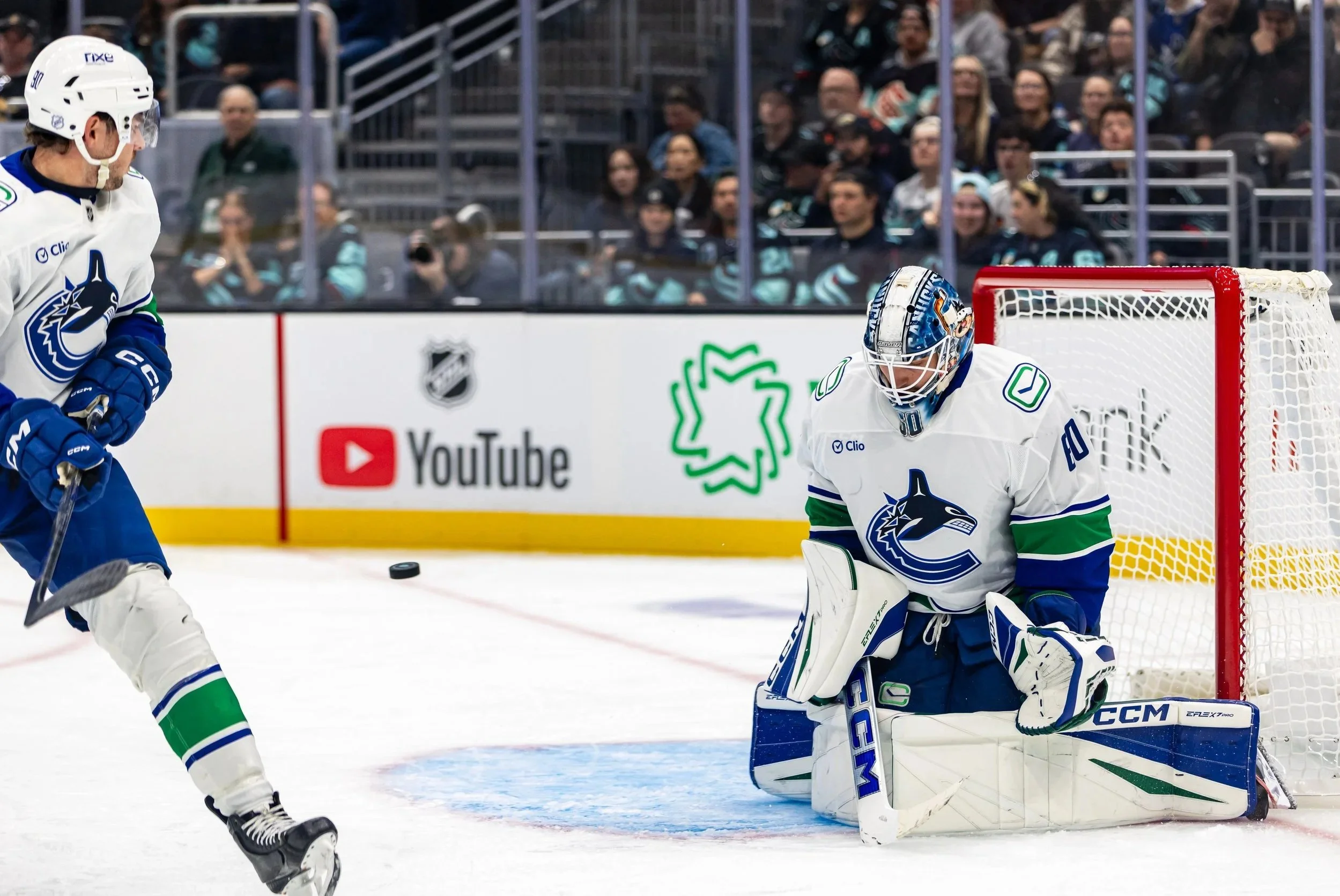
The Vancouver Canucks face the Seattle Kraken during a preseason matchup at Climate Pledge Arena on September 19, 2026. Photo by Jenn G.
Written by Josie Dinonsie
The Vancouver Canucks managed to sneak past a 10-game losing streak with an overtime win on Tuesday night, but one victory cannot undo the early-season issues. There are many questions to be answered in order to move on from the difficult start to the season.
Returning to the win column after battling back from a 3-goal deficit, beating the Anaheim Ducks in overtime was a step in the right direction. The 6-5 victory was certainly needed, and it proved the team can fight for wins, and show up on the power-play to get the job done.
Though the victory was a sigh of relief, it also opened the door to figuring out what systems were failing before. The lack of consistency and drive within the opening weeks is unacceptable for a team that is looking to grow into a competitive contender. Offensive potential was highlighted in the dramatic victory, but the fact that it took a last minute-push to secure the win, points to defensive problems that start the game off on a wrong note.
With now a 3-11-1 record, a lot of work is in the future. In order to form into true contenders, the focus has to shift from just surviving bad stretches, to sustaining a competitive style of play that works together to perform well every night.
Breaking down how the Canucks got to where they are now, a conversation about denying scoring chances has to be had. A main struggle this season so far has been allowing opponents to generate high-threat scoring opportunities, and not having the discipline and systems to shut it down. Head Coach Manny Malhotra discussed the team's defensive goals heading into the game against Anaheim.
“It’s a matter of us maintaining structure…For us, minimizing the amount of times they can get up the ice with numbers by being above, and then just defensively making sure we kill plays as quickly as possible to not allow them to roll around the zone,” Malhotra said.
Those focuses were key to figure out, as the Canucks goals per game allowance average was 4.62 heading into the game against Anaheim, second to last in the league. Other concerns included their penalty kill percentage, coming in at 64.4 %, they were dead last.
Coming into the game tied for 10th in amount of penalty minutes per game, the Canucks lack of shut-down ability on the penalty kill had a big impact on the team's early unsuccessfulness. Penalties immediately became an issue, placing pressure on Vancouver’s goaltending and whole defensive structure. Their ability to protect leads and come back from mistakes was fading away in many of the games this season.
Whether on the penalty kill or even strength, there's no denying that Vancouver needed to tighten up the defensive systems to allow less high-danger scoring chances. But the other end of the ice wasn't necessarily carrying the team either.
The Canucks offense has also struggled to produce numbers night after night. In all departments offense was lacking, including shots on net, and net front presence in particular. There have been a few recent games including Oct. 22 against Detroit, where the team barely recorded a double-digits number of shots.
Those tough games with little to no offensive spark illustrate Vancouver’s struggle to sustain pressure and maintain structure. It is impossible for a team to win games when both the offensive and defensive systems are failing to work together.
Though Elias Pettersson is on a hot streak to begin the year, and Jonathan Lekkerimäki is on the rise, the team needs a deeper offensive contribution. Throughout the lineup, each line and role has to step up to increase the offensive production. Individual efforts can not be the answer every night.
The good news is, late in Tuesday night's matchup, the team showed a glimmer of hope, a look into systems coming together and producing, doing their jobs at both ends of the ice.
“I’m really pleased with the response from the guys. That's the type of effort we’ve been looking for for a while now… we stuck with it, we applied a good amount of pressure, and then guys came up with some timely goals for us,” Malhotra said post-game.
For Malhotra, the goal now should be establishing how to keep playing like they did in the third period and overtime, and apply it to every game. Vancouver proved it can respond in a crunch but whether they can bring that effort into every moment on the ice, is what will determine the team's season. Turning those good moments from the past game into habits and an identity could turn their season around early.
Coming off of a 58 point season last year, Vancouver can only go upwards. And after ending a 10-game-losing-streak on a positive note Tuesday night, they have the opportunity to hopefully use that momentum as fuel for the rest of their season.
