
How Did the Rangers Go From Presidents' Trophy Winners to Last in the East?
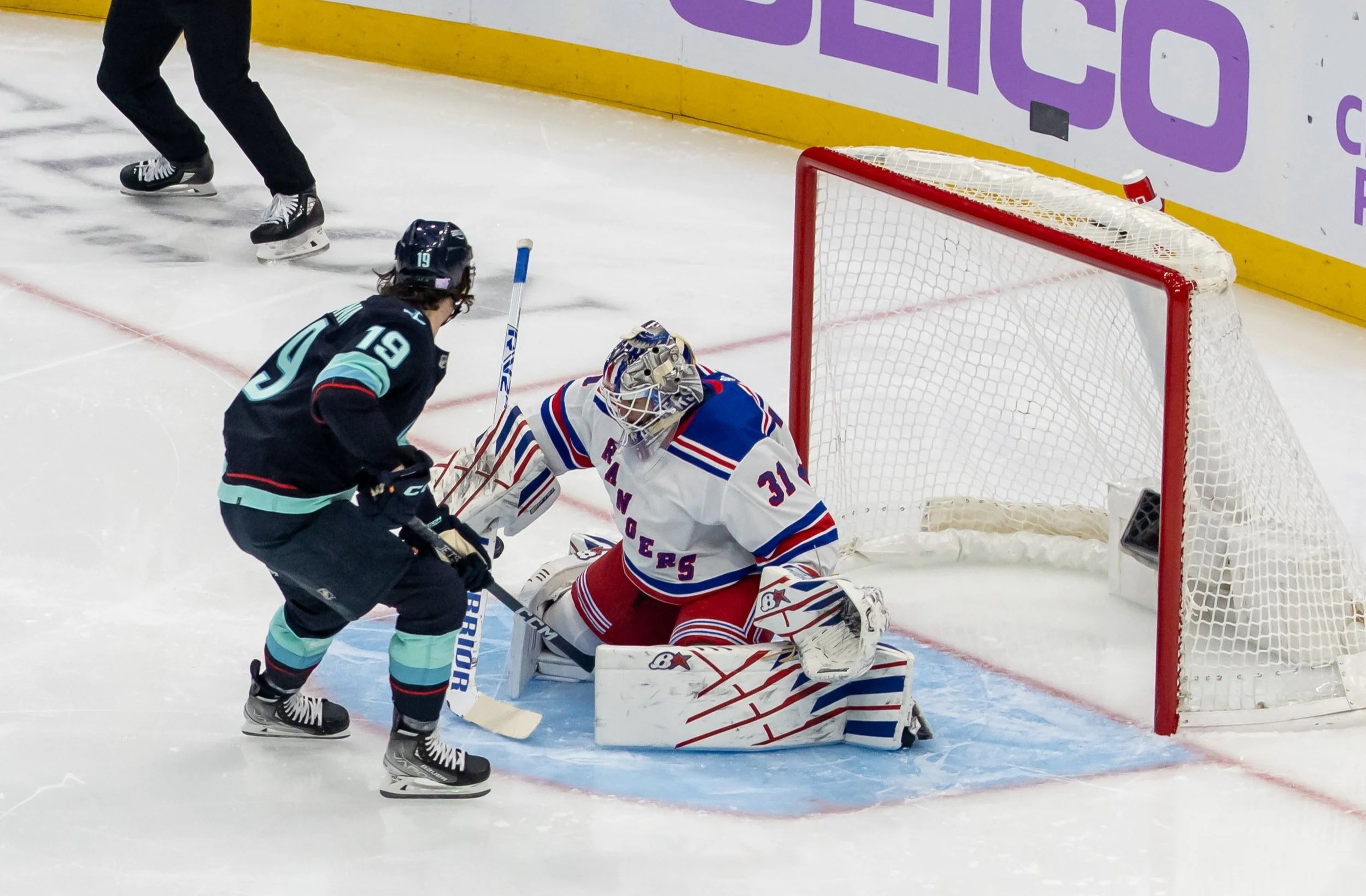
Seattle Kraken forward Jared McCann battles New York Rangers goaltender Igor Shesterkin at Climate Pledge Arena. Photo credit: Jenn G.
Written by Gina Anton
Two seasons ago, the New York Rangers looked like one of the NHL's model franchises. New York finished the 2023-24 regular season with a 55-23-4 record and 114 points, earning the Presidents' Trophy as the league's best regular-season team. The Rangers reached the Eastern Conference Final before falling to the Florida Panthers.
Two years later, they found themselves at the opposite end of the standings. New York finished the 2025-26 season 34-39-9 with 77 points, placing 16th in the Eastern Conference and eighth in the Metropolitan Division. The Rangers scored 235 goals, 23rd in the NHL, while allowing 249, marking their second consecutive season without a playoff appearance.
So how did a team that appeared built for a Stanley Cup run fall so quickly?
The Decline Started Before Last Season
The Rangers' collapse was not an overnight development. After their 114-point campaign, New York dropped to 85 points in 2024-25, finishing 11th in the Eastern Conference and missing the playoffs. The team then lost another eight points in 2025-26, highlighting problems that went beyond one disappointing season.
The roster that dominated the regular season in 2023-24 gradually changed as New York moved away from parts of its veteran core. Chris Kreider was traded to the Anaheim Ducks before the 2025-26 season, while defenseman K'Andre Miller was sent to Carolina. Those departures removed two important pieces from the team that had helped New York reach the Eastern Conference Final, and the Rangers eventually made an even bigger change when Artemi Panarin was traded during the 2025-26 season.
The Offense Lost Its Consistency
One of the Rangers' biggest problems was their inability to consistently generate offense. New York scored 278 goals during its Presidents' Trophy season, but that total fell to 235 two years later. The loss of established scoring talent played a role, but the larger issue was depth throughout the lineup.
A team can survive a quiet night from one star when other lines can consistently create offense. The Rangers increasingly lacked that secondary production. Mika Zibanejad led New York in scoring in 2025-26 with 78 points, while Adam Fox finished second with 44 assists. The Rangers needed more players to take on larger offensive roles as established veterans departed, but that transition did not happen quickly enough.
A Changing Identity
As the roster shifted, the Rangers also had to determine what their next competitive window would look like. The 2023-24 team was built around an experienced core, with Igor Shesterkin providing an elite safety net in goal. As that core changed, New York had to balance competing in the present with preparing for the future.
That has led to a younger, faster roster. General manager Chris Drury has described the organization's direction as a retool designed to make the team younger and faster while building around its core players and prospects. The Rangers continued that approach during the 2026 offseason, acquiring Pavel Dorofeyev from the Vegas Golden Knights and signing him to a seven-year, $77 million contract. They also added defensemen Sean Durzi and Marcus Pettersson, along with forwards Oliver Bjorkstrand and Joe Veleno.
The moves show that New York recognizes its previous formula was no longer working. The question is whether the new approach can produce results quickly enough.
Shesterkin Cannot Fix Everything
One thing the Rangers still have is a franchise goaltender. Shesterkin remains one of the most important pieces of the roster and gives New York a chance to stay competitive even when the team in front of him struggles. But even an elite goaltender can only cover so many weaknesses.
The Rangers allowed 249 goals in 2025-26, but their offensive production ranked 23rd in the league. That imbalance made it difficult to consistently turn strong goaltending into wins. New York also needed to improve its defense, and adding Durzi and Pettersson gives the blue line more depth behind Fox and Vladislav Gavrikov.
The Rangers Are at a Crossroads
The biggest question heading into 2026-27 is whether the Rangers can retool quickly enough to return to the playoffs or whether their decline requires a more significant rebuild.
There are reasons for optimism. Fox remains a top defenseman, Shesterkin remains a franchise goaltender, and Dorofeyev provides another proven scoring option. The additions of Durzi and Pettersson should also strengthen a blue line that needed more depth.
Still, a few offseason additions will not automatically recreate a team that won 114 points two seasons ago. The Rangers now have to prove that their new direction can produce more than a playoff appearance and ultimately build a team capable of competing for the Stanley Cup again.
Two years ago, New York had the NHL's best regular-season record. Now, the Rangers are trying to climb out of last place in the Eastern Conference, making 2026-27 a critical season for a franchise attempting to turn one of the league's most dramatic declines into a legitimate turnaround.
