
Martin St. Louis: From Undrafted to Unforgettable
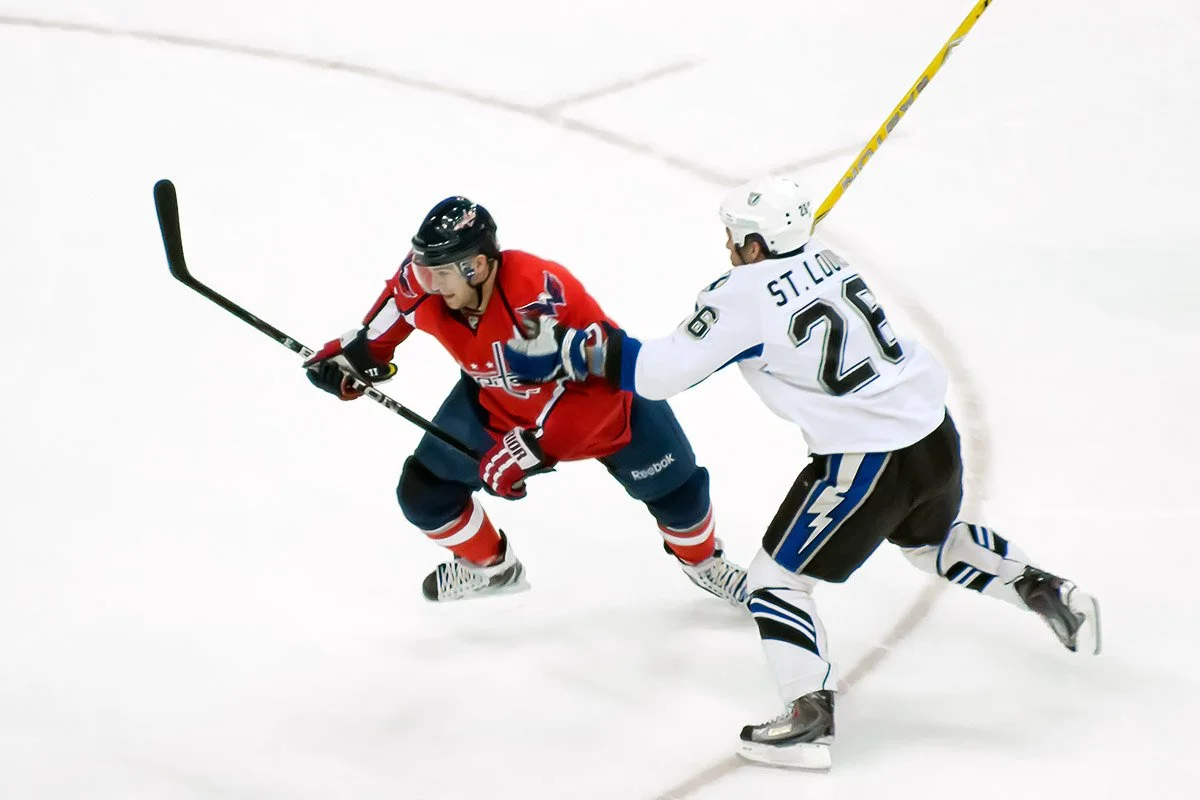
Washington Capitals defenseman Mike Green (#52) and Tampa Bay Lightning forward Martin St. Louis (#26) battle for position during an NHL game at Verizon Center in Washington, D.C., on January 4, 2011. Photo by Clyde Orama
Written by Josie Dinonsie
The start of Martin St. Louis’ professional playing career was defined by one constant challenge: proving he belonged. At just 5-foot-8, St. Louis was often overlooked because of his size, forcing him to overcome doubts that had little to do with his ability on the ice.
St. Louis had already established himself as a standout forward at the University of Vermont, where he finished with 267 points, a school record for the men’s hockey program. Yet despite his impressive production, his name was not called during the 1997 NHL Draft.
Rather than allowing that disappointment to define him, St. Louis began working his way toward the NHL. In 1997, he signed with the Cleveland Lumberjacks of the International Hockey League and recorded 50 points in 56 games. His performance earned him a contract with the Calgary Flames in 1998, giving the undrafted forward his first opportunity with an NHL organization.
St. Louis spent the next two seasons between the American Hockey League and the NHL, playing for the Saint John Flames and receiving brief opportunities with Calgary. Those call-ups were limited, but they gave him a chance to show that his game could translate to the highest level.
After the 1999-2000 season, the Flames bought out St. Louis’ contract, making him an unrestricted free agent. It was another setback, but it ultimately opened the door to the opportunity that changed his career.
The Tampa Bay Lightning saw something in St. Louis that others had missed. In July 2000, the team signed him to a two-year contract, giving him a fresh start and a chance to establish himself as an NHL regular.
St. Louis responded immediately. He recorded 40 points in his first season with Tampa Bay, proving he could compete at the NHL level. An injury limited him to just 53 games the following season, but he returned stronger in 2002-03, recording 70 points.
Then came the season that changed everything.
In 2003-04, St. Louis emerged as one of the NHL’s elite players. He recorded 94 points, winning the Art Ross Trophy as the league’s leading scorer and the Hart Trophy as its most valuable player. He also helped lead the Lightning to the first Stanley Cup championship in franchise history.
Winning the Art Ross and Hart trophies while also capturing the Stanley Cup in the same season is one of the rarest accomplishments in hockey. St. Louis became just the seventh player in NHL history to accomplish the feat.
His success continued long after that breakthrough season. In 2006-07, St. Louis set a career high with 102 points and went on to record several more seasons with at least 90 points. The player who once struggled to earn an NHL opportunity had become one of the league’s most consistent offensive stars.
St. Louis also found success beyond Tampa Bay. In 2014, he represented Canada at the Sochi Olympics, helping the team win a gold medal. Later that year, he was traded to the New York Rangers, where he continued to make an impact. St. Louis helped New York reach the Stanley Cup Final, although the Rangers ultimately fell to the Los Angeles Kings.
He finished his NHL career with two Art Ross Trophies, one Hart Trophy, three Lady Byng Trophies, one Ted Lindsay Award and a Stanley Cup. Across 1,134 regular-season games, he recorded 1,033 points.
The journey from undrafted forward to Hockey Hall of Famer was built on years of proving people wrong. St. Louis entered the NHL without the draft status or physical size that often opens doors for young players, but his skill, determination and consistency eventually made it impossible to overlook him.
He was inducted into the Hockey Hall of Fame in 2018, cementing a career that once seemed unlikely when his name went uncalled in 1997.
St. Louis never grew taller, but he never needed to. His career became proof that size does not determine how far a player can go. Sometimes, the players who begin under the radar are the ones who leave the biggest mark.
