
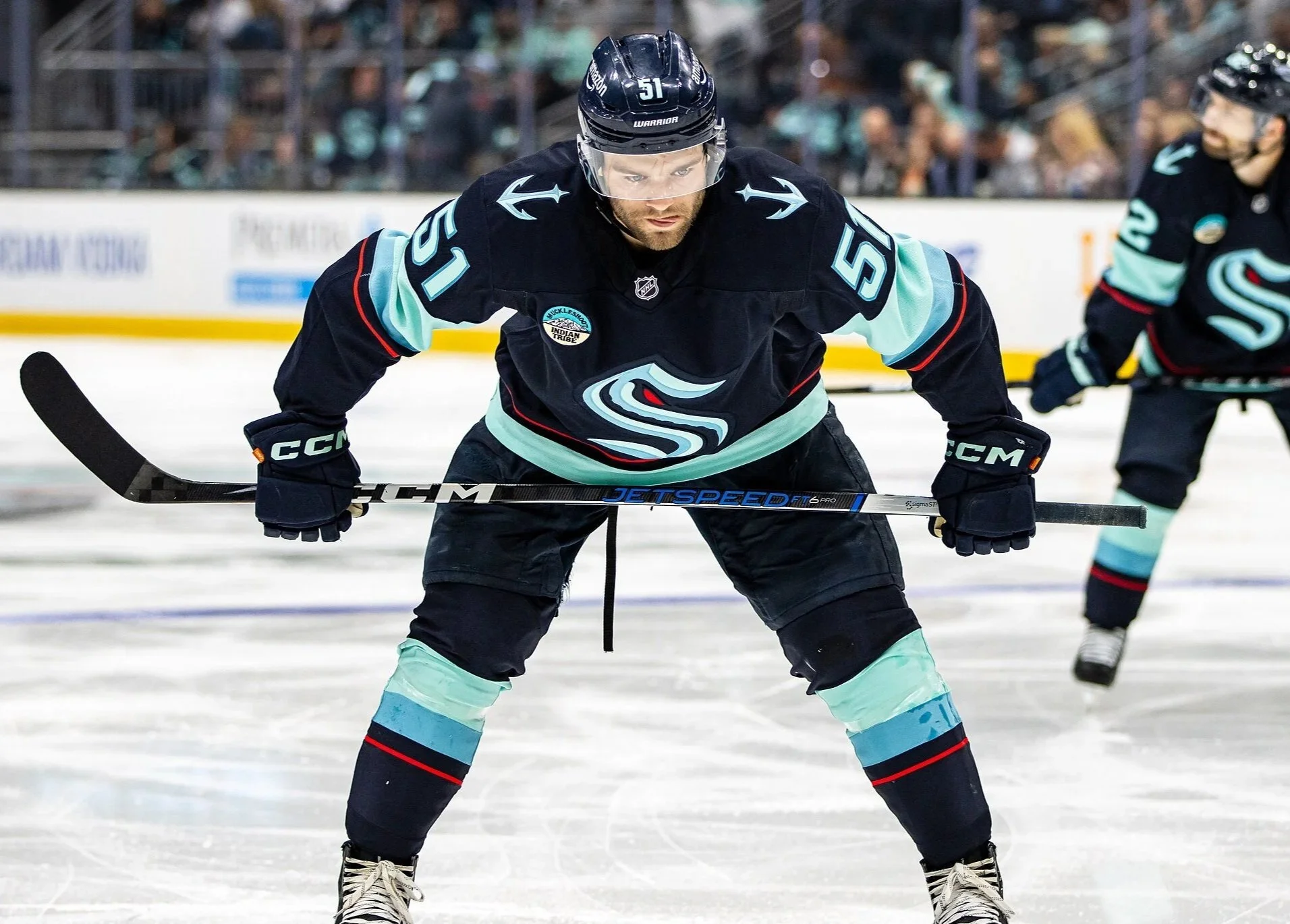
Shane Wright during a preseason NHL game between the Calgary Flames and Seattle Kraken at Climate Pledge Arena on September 22, 2024. Photo by Jenn G.
Written by Derrik Maguire
A generational talent. A player expected to not only become a star, but transcend a franchise and the game itself. The type of talent you only see every 10-15 years. That was the expectation surrounding Shane Wright.
Now, after his first month with the Nashville Predators, the pressure and expectations that came with that label are finally beginning to lift.
For the 2019-20 season, Wright was granted exceptional status by Hockey Canada to play in the OHL as a 15-year-old, becoming the sixth player to receive the designation alongside John Tavares, Aaron Ekblad, and Connor McDavid. During his age-15 season, Wright even scored at a higher pace than McDavid did at the same age, and the draft hype was beginning to take off.
There was just one problem: a global pandemic.
Wright’s only games for over a year came at the 2021 U18 Worlds, which he dominated. Meanwhile, players around the world continued playing a “normal” season. Even when Wright returned to the ice for his draft year in 2021-22, he was still viewed as a lock for the No. 1 pick.
As publications around the hockey world remained laser-focused on Wright, the question wasn't where he would be selected, but which team would be lucky enough to land an NHL-ready player who could become its next face of the franchise.
Wright was viewed as the best player in his class, the future No. 1 pick, and a generational talent. It was a year of #PainforShane as Canadiens fans made makeshift and custom Shane Wright jerseys after Montreal won the draft lottery.
Only for Montreal to select Juraj Slafkovsky instead.
Wright fell to fourth, where the Seattle Kraken selected him. For the NHL’s newest franchise, Wright was supposed to be the savior, still carrying the weight of that generational prospect label. But the drop to fourth overall told a story many overlooked.
While Wright missed a season, other prospects continued developing. Slafkovsky, for example, was winning tournament MVP at the Winter Olympics. Once viewed as NHL-ready, it took two full seasons before Wright could lock down a regular NHL roster spot.
Yet as Wright entered his fifth year with the Seattle organization, and his third in the NHL, trade rumors had already begun to loom. On November 1, Shane Wright was traded one-for-one to the Nashville Predators for Matthew Wood.
“You don't need to have the weight of the world on you. You're not the fourth-overall pick anymore. That was years ago. What you are is a good hockey player, and you still have growth in your game.”
That was the message Predators GM Chris MacFarland delivered to Wright following the trade.
Nashville isn't asking Wright to be the generation-defining player fans envisioned when he was 15. At 22, there is still plenty of room for growth. Wright has already shown he can produce at the NHL level, recording 44 points in 79 games during his first full season.
Although Wright went pointless in his first four games with Nashville, he recorded a goal and two assists in a 4-2 victory over Anaheim on November 11. Even if those are his only points through his first nine games with the Predators, Wright has shown that he can contribute beyond the scoresheet.
He is +5 with Nashville and has never had a negative plus-minus in any professional season. While the points will come, Wright has always been a defensively sound center willing to make the right play.
Wright has never been the flashy, highlight-reel type of player associated with a generational talent. If anything, that was one of the biggest knocks on him entering the draft.
Some tried to remove the generational tag, not as a negative, but as a recognition that Wright didn't need to be a generational prospect to become a great player. He was even compared to Patrice Bergeron during the pre-draft process. Bergeron never carried a generational label, but he is now a Hockey Hall of Famer.
“We think he's a natural fit in the middle of the ice, and we feel we've got a great opportunity for him to improve day-by-day, and he'll be a better player in the spring than he is now, and he'll be a better player next fall than he is now… I hear nothing but good things about Shane, so we're excited today,” MacFarland said after the trade.
MacFarland wasn't the only one excited about the move. Speaking to the media following his first practice, Wright could not stop smiling.
“Super excited, really looking forward to being here and being part of this group. I think I'm just overall excited to be part of the team. Nice to be able to get here, get a practice in before tomorrow's game, but really excited to be here,” Wright said.
The trade to Nashville has given Wright a chance to reset and find his footing alongside a number of veterans he can lean on, including linemate Filip Forsberg, Steven Stamkos, Jonathan Marchessault, Ryan O’Reilly, and captain Roman Josi.
Wright has been consistent in saying he wants to play with speed, contribute to the Predators, and grow with the organization beyond this season.
Wright doesn’t need to be the player people envisioned when he was 15. He needs to be the player Nashville believes he can be today.
For a young player who has spent much of his career being measured against expectations set before he could even enter the NHL, that opportunity could be more important than any previous accomplishment on the ice.
