
Team USA Chases Another Gold at the World Juniors
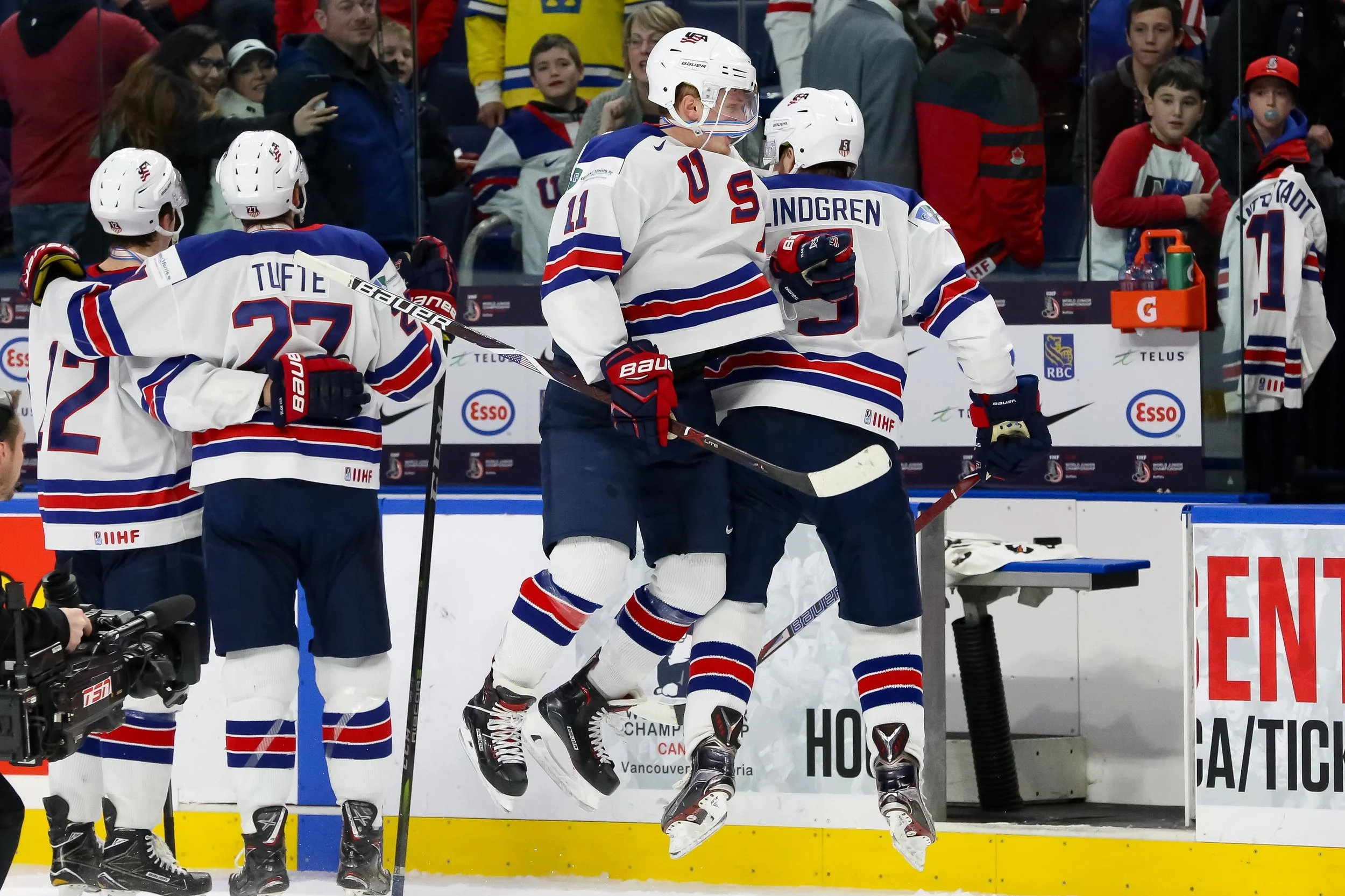
Team USA players Ryan Lindgren and Casey Mittelstadt celebrate winning bronze at the 2018 IIHF World Junior Championship in Buffalo, N.Y. Photo credits: Anders Marshall/Euro Hockey
By Gina Anton
In 2018, the U.S. men’s national junior team stood on the World Junior Championship podium with bronze medals around their necks. It was a respectable result, but it also felt like a reminder that the United States was still chasing consistency on hockey’s biggest under-20 stage.
Fast forward to today, and Team USA is no longer chasing. They are starting to set a very consistent standard after steadily climbing the ranks in recent years and winning gold in 2024 and 2025.
Over the last several tournaments, the Americans have transformed from a talented but unpredictable group into a gold-medal threat, built on elite development, depth at every position, and a pipeline that feeds directly into the NHL. As another World Juniors unfolds, the question isn’t whether Team USA belongs at the top, but whether this year’s group can develop the chemistry needed to win for a third consecutive year.
The bronze medal in 2018 marked a transition year. That roster was loaded with skill, but the U.S. program was still refining its identity after years of inconsistent outcomes. Since then, the emphasis has shifted toward faster, more aggressive forechecking; defensemen who can move the puck under pressure; and goaltending developed through the national program rather than patched together. USA Hockey doubled down on its long-term development model, and the results have been undeniable.
What separates the U.S. now is depth. Fourth-line forwards pressure like top-six players, and defensive pairs are interchangeable.
College Hockey to the NHL
One of the defining features of Team USA’s rise is how many players develop through NCAA programs before turning pro, giving them maturity and structure before entering the NHL.
Recent World Junior standouts have followed a familiar path. Many, such as James Hagens, Cole Eiserman, and Cole Hutson, are drafted by NHL teams as teenagers. They spend one or more seasons in college hockey, facing older, stronger competition before transitioning quickly to the NHL, where they often contribute immediately. This model has produced players who arrive in the NHL more polished, defensively responsible, physically prepared, and mentally mature.
This year’s team is built to win. The current Team USA roster fits the same blueprint as the two years prior, featuring high-end skill, puck-moving defensemen, and confident goaltending. Many of these players compete at a high level already, and some are even on fast tracks to the NHL. The chemistry is evident amongst the players, and the experience gained from previous gold-medal runs gives this group the edge they need.
Winning gold at the World Juniors is never guaranteed. The margins are thin, and powerhouse nations like Canada, Sweden, and Finland are always capable of making a run.
What started with a bronze medal and inconsistency has evolved into a culture of winning. Team USA is now playing to defend its place at the top, and another gold medal is well within reach.
