
What Does Improvement and Self-Discipline Look Like at Hockey's Highest Level?
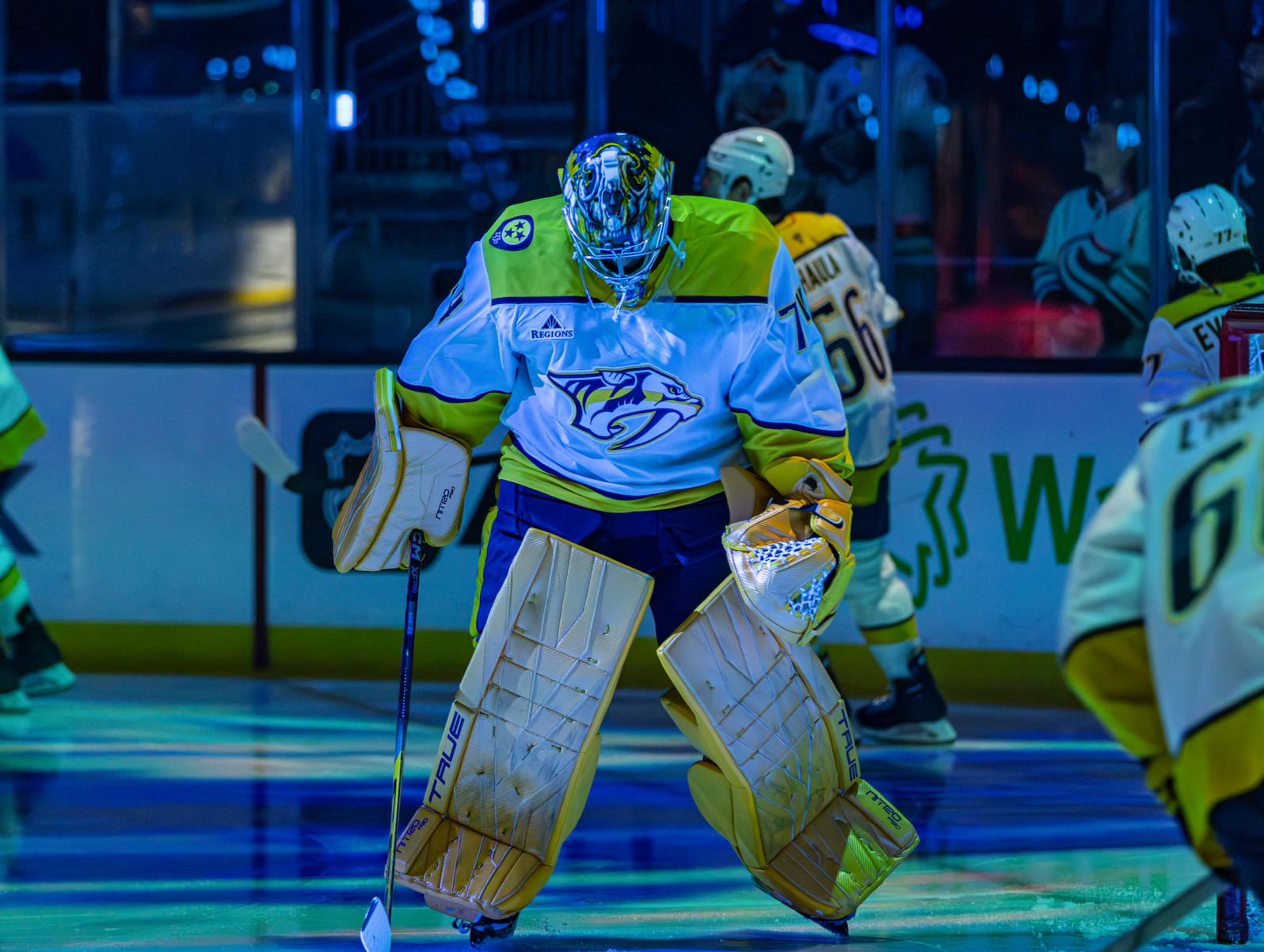
Nashville Predators goaltender Juuse Saros warms up before a matchup against the Seattle Kraken at Climate Pledge Arena on March 10, 2026. (Photo by Jenn G)
Written by Gina Anton
Making the NHL is the dream. But what happens once a player gets there?
At hockey's highest level, talent has already taken every player in the room a long way. What comes next can be found in the details: how a player prepares, recovers and approaches the parts of their game that still need work.
Juuse Saros offered a glimpse into that process during a preseason interview last week.
When asked about his offseason preparation, the Nashville Predators goaltender said:
“In a fitness level, I feel good. On the ice we always try to find ways to get better as well. There is always something you gotta work on.”
Feeling physically ready does not mean the work is finished. For a player who has already established himself in the NHL, improvement can become less about reaching a new level and more about identifying what still needs attention.
That can look different for every player. Preparation, recovery, conditioning and the smaller routines around a season all become part of the job, particularly when the physical demands of an NHL schedule leave little room for neglecting them.
For goaltenders, that preparation comes with its own demands. The position requires physical readiness while also asking players to manage the mental side of facing shots, recovering between games and maintaining consistency throughout a long season.
Saros has spent years navigating those demands. Last season, he appeared in 59 games for Nashville and made 1,519 saves, the most in the NHL.
He has already begun preparing for another season, making 20 saves in Nashville's preseason opener against the Tampa Bay Lightning on Sept. 20.
But Saros' comment points toward something broader than a preseason routine. Once a player has reached the NHL, there is no longer a new level to chase simply by making the league. The challenge becomes deciding what deserves attention next and having the discipline to keep working on it.
That can mean improving something that nobody watching from the stands will notice. It can mean recovering properly after a difficult stretch, making a small adjustment in practice or continuing to work on a weakness that may never completely disappear.
Saros does not have to explain what that looks like for every player. His answer offers a look at how one established player views his own preparation.
He feels good. He is already here. But he is still evolving, always finding something to improve on.
Maybe that is what self-discipline looks like at hockey's highest level: not assuming that reaching the NHL means you have finished developing, but continuing to find the next detail worth working on.
