
Edmonton’s Biggest Challenge Without Draisaitl Isn’t Scoring, It’s Finding Flow
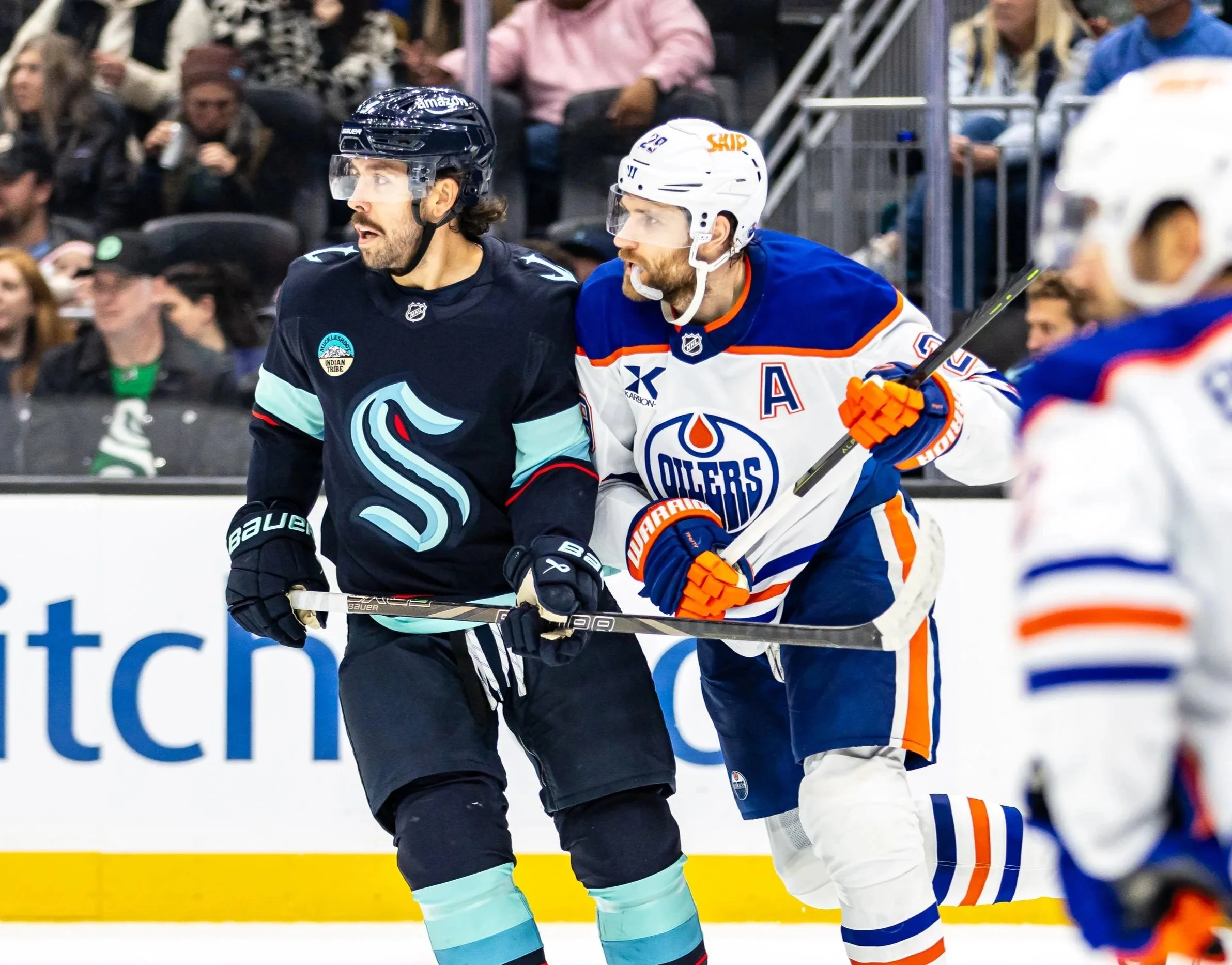
Leon Draisaitl of the Edmonton Oilers skates past Seattle Kraken center Chandler Stephenson during the Oct. 25, 2025 matchup at Climate Pledge Arena. Photo credit: Jenn G.
Written By Gina Anton
The Oilers have lost their rhythm. When Leon Draisaitl exited after scoring in a 3–1 win over Nashville, it extended a point streak that had quietly stabilized Edmonton’s offense at a critical time of year. Now, with confirmation that a lower-body injury will sideline him for the remainder of the regular season, the question isn’t only who replaces his production, but who replaces his timing.
Draisaitl’s raw numbers tell part of the story: 35 goals and 97 points in 65 games, plus 186 shots on net. But the Oilers’ challenge runs deeper than totals. Those numbers were accumulated with remarkable consistency, he was in the middle of a nine-game point streak when the injury occurred.
That kind of reliability is difficult to redistribute.
“You don't fill the void,” Oilers captain Connor McDavid said Monday. “We have lots of guys in here that can lead. We have lots of different guys that have a voice in here. Obviously he's got a big one. If he's not playing for a little bit or if he is, it doesn't matter. We need leaders this time of year and we need our group to be lively and energetic and that's with or without him in the lineup.”
A Different Kind Of Absence
In many cases, losing a top scorer means spreading out offense. Edmonton’s situation is trickier. Draisaitl’s impact often came in sequence, goals that opened games, touches that extended pressure, shifts that tilted momentum. He even scored before leaving his final game, a snapshot of how routinely he influenced outcomes.
Now, the Oilers are left with 14 games in the regular season to recalibrate without that built-in flow.
Head coach, Kris Knoblauch struck a measured tone earlier in the week, saying he was optimistic the injury wouldn’t be long-term. But “long-term” has quickly become “regular-season-ending,” and that distinction shifts the conversation from recovery to adaptation.
The Ripple Effect Down The Lineup
The immediate response won’t come from a single player. Instead, it will emerge in layers.
Middle-six forwards such as Jason Dickinson and Josh Samanski are now positioned for expanded roles, an indication that Edmonton may lean less on top-heavy scoring and more on depth distribution.
Without Draisaitl, the Oilers lose a player who could both finish and facilitate at elite levels. His 97 points weren’t just volume, they were balance, nearly split between goals and assists, allowing him to drive offense regardless of situation.
The Oilers remain a playoff-caliber team, but this stretch will define how they get there.
For a roster built around star power, the absence of one of “the best hockey players in the world” forces a subtle identity shift. Do they double down on their remaining elite talent, or do they evolve into something more committee-driven?
The answer over the next few weeks may matter as much as Draisaitl’s eventual return.
Because when he does come back, whether early in the playoffs or later, the Oilers won’t just need his production. They’ll need to have learned how to survive without his rhythm.
