
Victor Hedman’s Decision to Step Away Shows What Leadership Really Looks Like
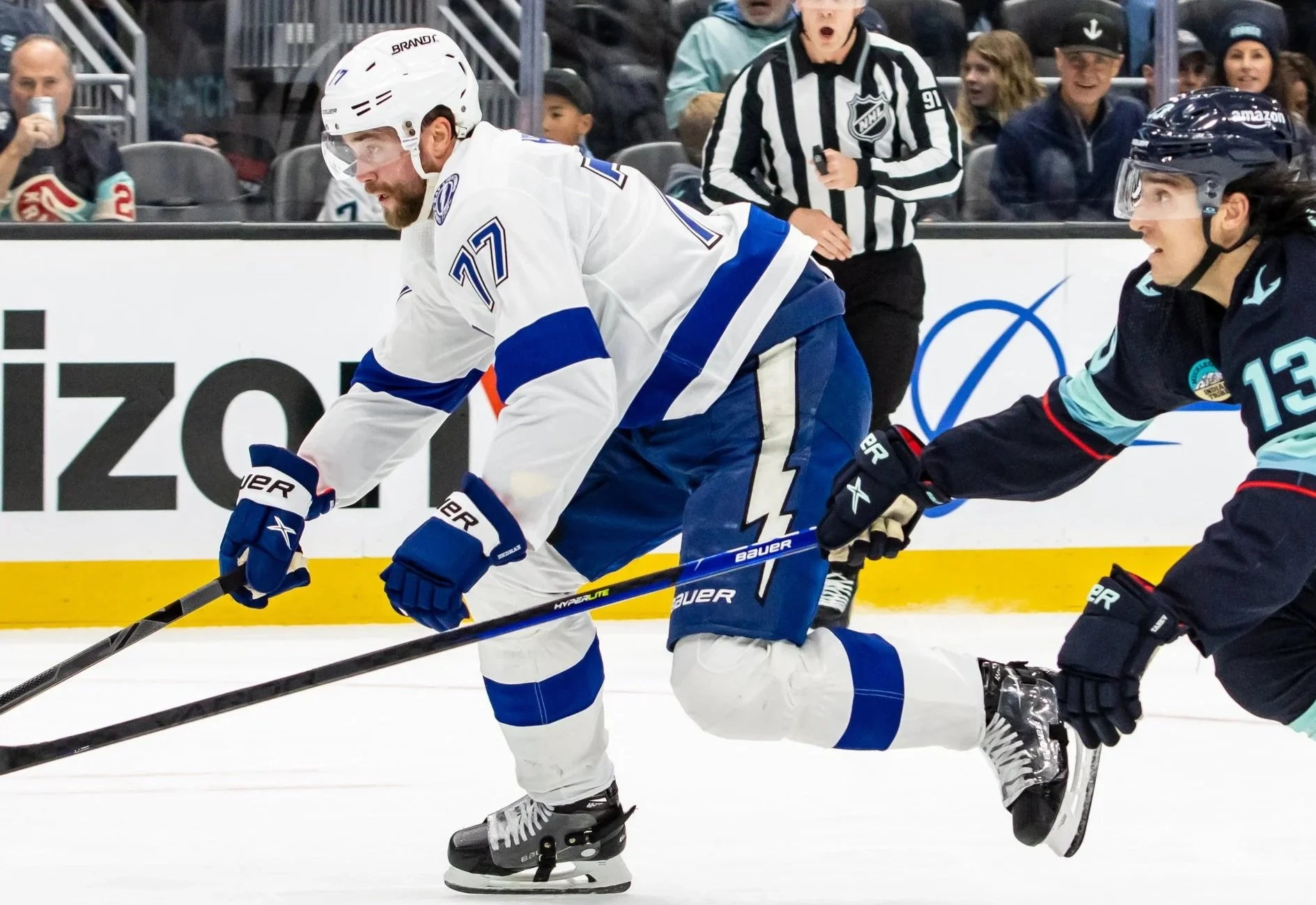
Victor Hedman of the Tampa Bay Lightning skates during a matchup against the Seattle Kraken at Climate Pledge Arena on December 9, 2023. Photo by Jenn G.
Written by Gina Anton
Victor Hedman has spent nearly two decades being the player Tampa Bay turns to when the pressure is at its highest.
But last season, the Lightning captain faced a challenge that could not be solved by another shift, another practice or another playoff run. He needed to step away.
Hedman took a personal leave of absence in March, later revealing that the decision was connected to his mental health. As he prepares for his 18th NHL season, the 35-year-old defenseman is looking back on that decision without regret, and with a renewed perspective on what it means to be a leader.
“I felt it was important for me to (take the leave) to get a handle on everything mentally and physically,” Hedman told NHL writer Dan Rosen on Tuesday.
For Hedman, stepping away was not about abandoning his responsibilities to Tampa Bay. It was about recognizing that he was not in a position to give the team what it needed from him.
“Someone told me that for good leaders, sometimes doing the right thing for the team is to kind of step away. I thought that was the right decision for me. I wasn't myself on the ice. I felt I wasn't helping the team. So, I felt the best thing for the team was for me to focus on myself away. I don't regret that decision at all. It was the right thing to do.”
Hedman last played on March 19, when he logged only 4:44 against the Vancouver Canucks. Tampa Bay announced his personal leave on March 25, and he ultimately missed the remainder of the regular season and the Lightning's seven-game first-round playoff series against the Montreal Canadiens.
The decision came after a difficult season physically as well. Hedman missed 34 games because of injuries before the 2026 Winter Olympics, including a stretch of 22 games following an elbow procedure. He later suffered another injury during warmups before Sweden's Olympic quarterfinal against the United States and was unable to play.
But the physical setbacks were only part of what Hedman was dealing with.
“For me, it was not really feeling low, but it was performance anxiety, kind of feeling that pressure in your chest as soon as a game day would hit,” Hedman said. “It kind of locks you up. You make a mistake, and in the past you'd be able to shake it off, but I couldn't do that. And I wasn't feeling 100% physically.”
Performance anxiety is not something most fans associate with a player who has spent his career performing under some of hockey's brightest lights.
Hedman has won two Stanley Cups, a Norris Trophy and a Conn Smythe Trophy. He has served as Tampa Bay's captain and built a reputation as one of the NHL's most dependable defensemen.
Yet none of those accomplishments made him immune to the pressure he was experiencing. That is what makes his decision to speak openly about it significant.
Rather than continuing to play through something he knew was affecting him, Hedman chose to take a step back. His focus now is on returning to the ice feeling healthy in both body and mind.
“For me, it's just feeling healthy and feeling like my body is where I want it to be,” Hedman said. “You're on the ice every day, you're in the gym, and you feel good, and that makes, obviously, the mental part easier too when you feel you can perform in your job to the fullest extent. I'm sure it's going to take me a few games to get back into the rhythm of playing in the league since I haven't played in a long time, but I'm super fresh, hungry, and super motivated to go out there and play my best hockey.”
There will understandably be an adjustment period. Hedman has not played since March, and he acknowledged that getting back into the rhythm of an NHL game will take time.
But his return carries more significance than simply getting a star defenseman back into Tampa Bay's lineup.
Hedman's willingness to discuss his experience also opens the door for conversations that are often difficult to have in professional sports.
Players are expected to perform through injuries, pressure and adversity. Mental health struggles can be harder to recognize, particularly when an athlete continues to appear capable of competing at the highest level.
Hedman wants others to know that struggling does not make someone less capable, less committed or less of a leader.
“The stigma, I think it's getting a lot better, but it's still probably there,” Hedman said. “At the same time, people go through this, and it's a lot more people than you think. It's good to be able to put it out there, that it's OK not to be OK.”
That message reaches beyond the Lightning.
For teammates, young players entering professional hockey and fans who may recognize some of what Hedman described in their own lives, his openness can serve as a reminder that asking for help does not have to mean stepping away from who you are.
Hedman's career has already established his legacy on the ice. His championships, individual awards and years of leadership speak for themselves.
But his decision to step away may offer another definition of leadership, one that has little to do with playing through everything and everything to do with recognizing when something needs to change.
Sometimes, the strongest decision an athlete can make is knowing when to step off the ice.
